
New Hanover City Directory Holdings
Wilmington is the central shelf location for New Hanover city directories, but the subject reaches across the county's coastal communities. The Local History Room brings together directories, maps, annual listings, yearbooks, newspapers, microforms, family papers, and related material for Wilmington, Carolina Beach, Kure Beach, Wrightsville Beach, and unincorporated New Hanover. Its directory run is strongest as a physical collection, with selected editions available online. A search should record the exact edition, not merely the decade, because coverage is uneven.
| Collection | Years | Where held | Access |
|---|---|---|---|
| Wilmington historical directories | Identified runs from 1860-61 through 1930; local run from 1963 to the present | New Hanover County Public Library Local History Room | Noncirculating, in room |
| Kelley, Smaw, Haddock, Sheriff and Branson directories | 1860s through 1896, in identified editions | Local History Room and cited local lists | Consult the named volume |
| Hill Directory Company | 1909-10 through later twentieth-century runs; 1911-12 digitized | Local History Room; UNC Wilson Special Collections | In person or online selection |
| Street indexes and reverse listings | 1883 special index and later street sections | Local History Room | Address and cross-street work |
Gaps are part of the evidence. An unlisted year may reflect a missing edition, a different municipality, a boarder omitted from the book, or a name indexed under a variant. Note: The shelf is better evidence than an assumed continuous run.
New Hanover Local History Desk
The Local History Room is the practical access point when a digitized result ends too soon. The collection does not circulate. It is open Monday through Thursday from 10 to 7 and Friday through Saturday from 10 to 5. Researchers register on arrival, use pencil, handle one box or volume at a time, and may use a camera or laptop without flash. Microform readers plus book and photo scanners make fragile directory pages easier to inspect and preserve in notes.
The local directory list is a useful inventory before the visit, while staff can help distinguish a shelf-held edition from a digital record or a licensed newspaper source. Ask for the year, surname, street, and source type. That request is more workable than a broad request for family information.
View the local directory source list before an in-person search.
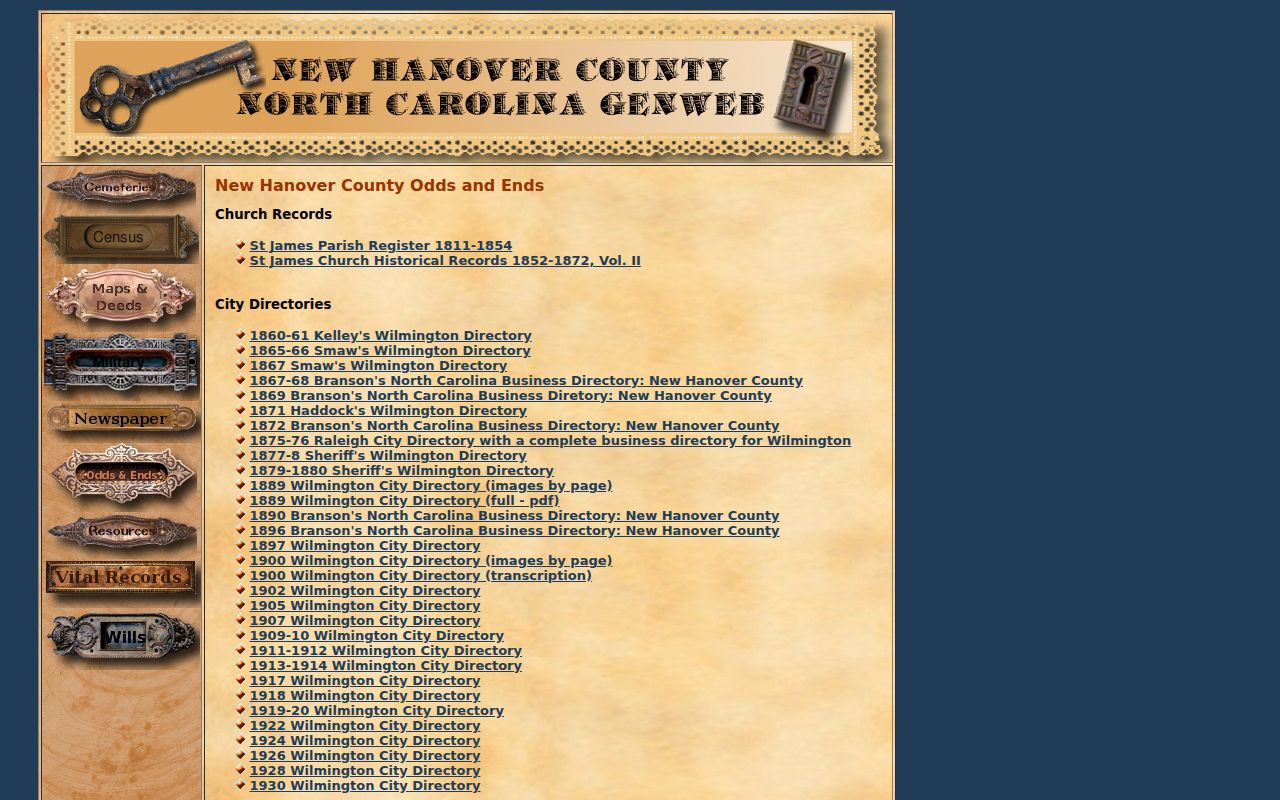
The source list supports a year-by-year approach and shows why one directory search should not stand in for every period.
New Hanover City Directory Years
The identified Wilmington sequence includes 1860-61, 1865, 1867, 1871, 1875, 1877, 1881, 1883, 1889, 1895, 1897, 1900, 1902, 1905, 1907, 1909-10, 1911-12, 1913-14, 1917, 1918, 1919-20, 1922, 1924, 1926, 1928, and 1930. Kelley, Smaw, Haddock, Sheriff, Branson, and Hill appear among the publishers. The DigitalNC record for the 1911-12 Wilmington directory identifies a Hill Directory Company volume held in UNC Wilson Special Collections.
- 1860-61: Kelley material begins the identified sequence.
- 1865-1871: Smaw editions and Haddock's 1871 directory add early city coverage.
- 1877-1896: Sheriff and Branson business material appear among the local listings.
- 1900-1930: more frequent identified Wilmington editions support closer household tracking.
- 1963-present: work backward through the Local History Room's later local run.
Publication labels do not guarantee that every resident appears. Use a directory year as a dated observation, then test it against a census, newspaper, cemetery record, or deed trail.
Reading New Hanover City Directory Entries
The 1900 Wilmington directory transcription reports about 9,203 names and includes general, business, court, church, cemetery, club, government, and street-guide sections. A short line can join the resident's name, a work role or listed organization, and a home address. In the sample entries, h precedes the home address, bds marks a person who boards or lodges, and wid identifies a widow. These are source-period labels, not modern identity categories.
| Name | Indexed person name, often with initials that distinguish same-name residents. |
|---|---|
| Role or organization | A listed occupation, office, employer, or community role that can become a second search term. |
| Address | h means home; the number and street can be checked against the street guide. |
| Boarding notation | bds means boards or lodges, not property ownership. |
| Widow notation | wid preserves the historic editorial notation and may point to another surname. |
- Criss-cross section
- A street-order section that helps move from an address to listed occupants in later directories.
- Householder index
- An alphabetical finding aid for the person or household under the printed indexing rules.
- Abbreviation key
- The volume's code list. Photograph or transcribe it before expanding unfamiliar marks.
- bet
- Between, often used with two cross streets in older address descriptions.
The 1900 source also uses a historical asterisk marker for Black residents. Preserve that classification carefully when transcribing; it reflects the book's period system and should not be turned into a modern assumption.
New Hanover City Directory Street Clues
Alphabetical results are only one half of a historical-directory search. The 1883 special index and later street sections can locate an address even when a surname is uncertain. Before 1883, Wilmington entries can describe a place as between two streets instead of giving a modern number. The 1900 street guide also preserves the older grid: numerical streets run north and south from Market Street, and Second Street extends east toward higher numbers.
Older names complicate a modern lookup. Mulberry and Grace, along with numbered-street variants, can appear in historical material. Compare the printed name, the cross streets, and the house number before entering a modern address in GIS. The full contemporary address chain belongs in the New Hanover street directory, while the historic volumes remain the historical address source.
Note: A street name change can create a false negative even when the household appears in the printed volume.
Tracing a New Hanover Household
Use the annual volumes as snapshots, not proof of title or a complete household. Start with the first confirmed surname and address. Follow the household through the nearest available editions, recording each spelling, address, role, and notation. A move becomes stronger when the next directory, census, or newspaper places the same person in the next location.
- Find the earliest confirmed appearance by surname, initials, and street clue.
- Check the next available city directory and record any new address or listing change.
- Use the street section to test nearby listed occupants and cross streets.
- Pair 1900 with the 1900 census, then pair 1910 and 1920 directory years with their census periods.
- Use a cemetery register, obituary, probate file, or later deed only to test the apparent end of the trail.
A disappearance can mean a move, death, boarding arrangement, spelling shift, different municipality, or omission. It does not by itself establish which event occurred.
New Hanover Historical Companions
The Cape Fear History resources add Wilmington newspapers, more than 1,300 North Carolina Room maps, Old New Hanover Genealogical Society material, and Bill Reaves Block Books. The Reaves books organize address-based newspaper clippings, often from the 1860s through the 1930s, with gaps. They can add a building, owner, event, or construction notice when a historic volume gives only a short entry.
Search the surname, address, old street name, cross street, and likely church, school, or organization. Sanborn maps identified for Wilmington span 1889, 1893, 1898, 1904, 1910, and 1915, with later supplements, so they can test a building's footprint and use without claiming who lived there.
See the digitized 1911-12 directory record for a searchable collection entry.
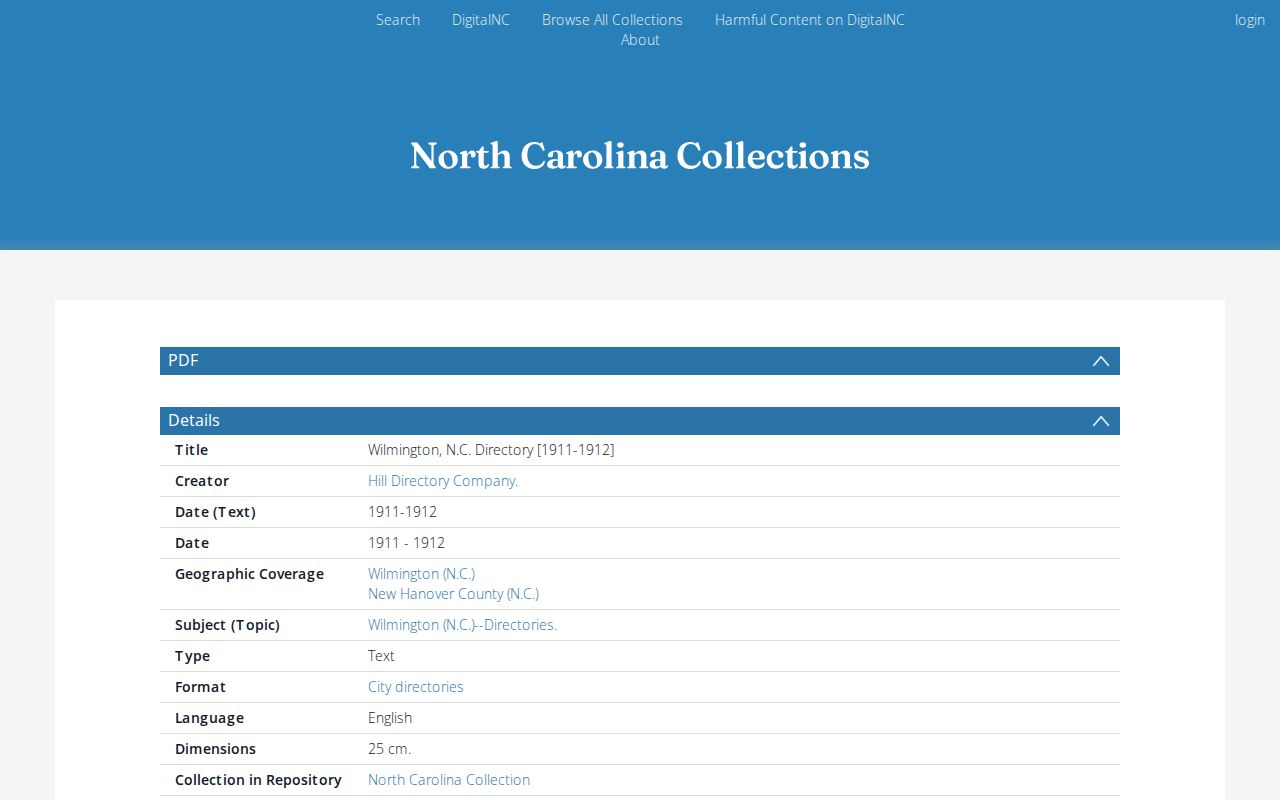
The digital record confirms a specific edition and holding, while the Local History Room remains the fallback for other years and formats.
New Hanover City Directory Gaps
Historic directories record people unevenly. Boarding-house residents, women, children, renters, and Black residents can be absent or classified through the source's historical conventions. An address may belong to a parcel owner while a directory lists a different occupant. A person can also appear in a Wilmington volume while a beach or unincorporated address is kept under another jurisdictional label.
For an unresolved result, add cemetery registers, yearbooks, newspapers, maps, estate records, or the State Archives county guide to the search. The guide identifies estate records from 1741-1939 and wills from 1732-1864, among other county series. These sources fill different gaps; none converts a missing directory line into a conclusion.